Wolf ventilation · hoods and blowers
Wolf Hood Repair, Link by Link
Most of a Wolf ventilation system is out of sight. The hood is merely the visible end of a chain that runs through filters, a blower, a stretch of duct and a damper before reaching open air, so when smoke stops rising into it, the weak link is often somewhere you cannot see from the stove.
Score from reviews 4.8 / 5 from 187 reviews About these reviews
- Reserve a stop on the routeBook online
- Ring the trailhead, any hour(213) 516-4020
- $89one trip fee, stops 8–6 daily
Compass check 1 of 3
Who repairs Wolf ventilation hoods near Calabasas?
Calabasas Wolf Service fixes every style of Wolf ventilation, from chimney and island canopies to pro hoods, liners tucked into cabinetry and pop-up downdrafts, in Calabasas and ten neighboring cities. The trip costs one $89, credited once a repair goes ahead, and having the range or cooktop under the hood checked on that stop adds nothing. The fix gets priced once the fault is found and before a single part is ordered.
The chain behind the stainless
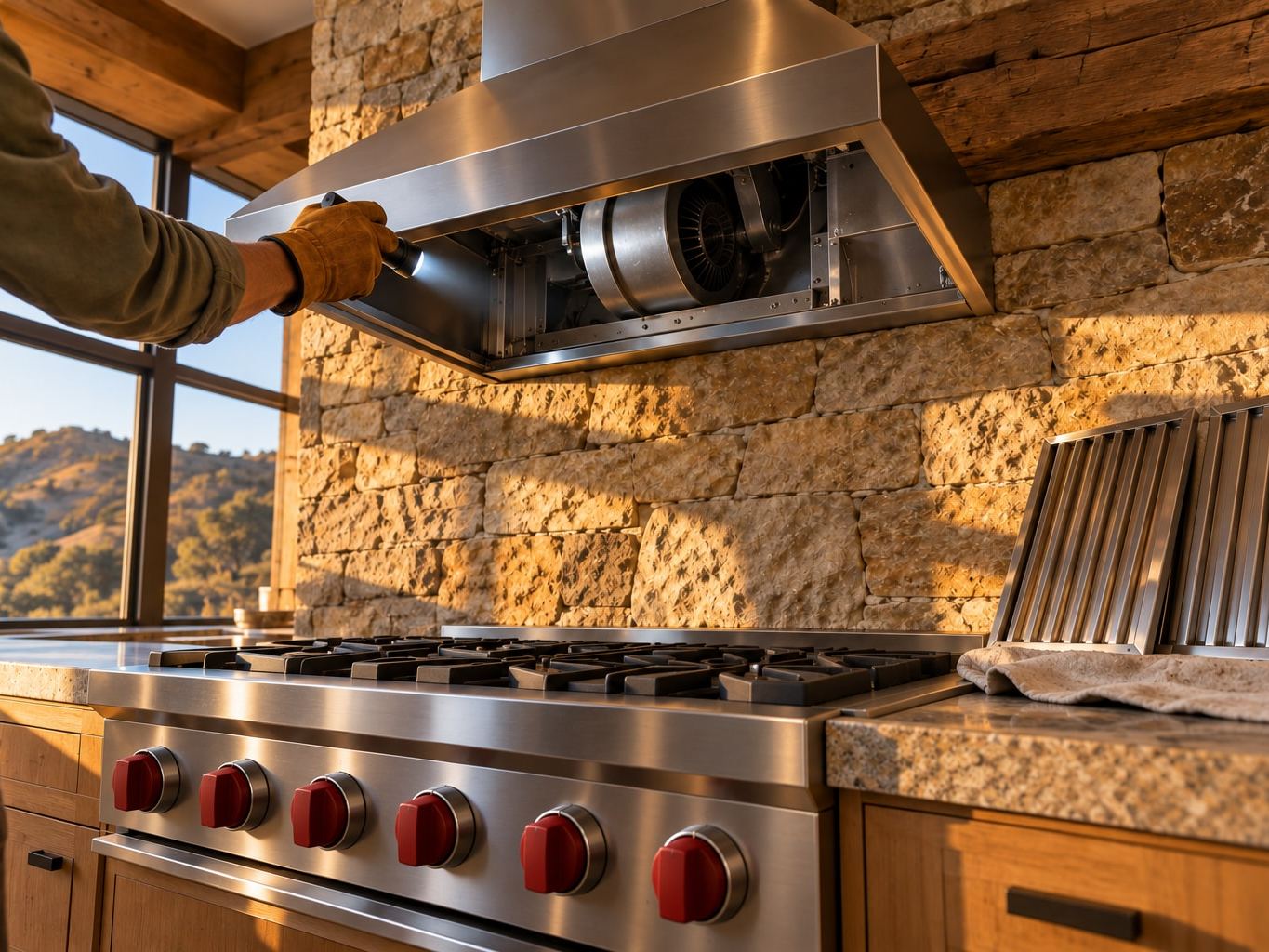
The hood. Chimney canopies on a wall or over an island, pro-style hoods, liners concealed in custom millwork and downdrafts lifting from the counter all share one purpose: capture the heat, grease and steam climbing off the cooking surface. The canopy carries the controls, the lights and, on some pro models, a sensor that wakes the fan automatically once the burners beneath throw off enough heat. How the hood lines up with the cooking surface matters as much as the hardware, which our article on kitchen layout for Wolf appliances explains.
The filters. Stainless baffle filters catch grease by forcing the air through sharp turns. Once they are loaded, they choke airflow long before anything electrical has gone wrong, and a filter seated at an angle lets air slip around it unfiltered.
The blower. Depending on how the kitchen was built, the motor sits inside the hood, somewhere along the duct, or outdoors on the roof or an exterior wall. That location shapes the repair: a blower inside the hood is reached from below, while a remote one may need roof or attic access, so mention it when you book.
The duct and damper. Exhaust travels through ductwork to a cap up top or on a side wall, and a backdraft damper stops outdoor air from dropping back in while the fan rests. A flap frozen closed, a flattened flexible section or a cap stuffed with leaves or a nest makes even a healthy blower sound strained and pull weakly. Gusty dry-season winds can also set a loose damper tapping. If your kitchen was remodeled, integrating Wolf into a renovation touches on why duct planning matters.
Compass check 2 of 3
Why is my Wolf hood fan not working?
Lights on but no fan points to the motor, the capacitor that helps it start, or the relay and control that give it power; a remote blower adds the long wiring run as a suspect. If nothing responds, check the breaker. A fan that spins but barely moves air usually has loaded filters or a blocked duct, not a bad motor.
Complaints and the link they point to
People describe ventilation trouble in a handful of ways. Each one tends to lead to a particular part of the chain.
- Smoke curls past the hood edge even on the top speed
- Loaded filters, a restriction in the duct, or a hood that is small for the cooking surface below it
- The fan roars yet steam hangs in the kitchen
- A damper stuck closed or an exterior cap that is blocked
- A rattle or tick that changes with fan speed
- A loose blower wheel, debris in the housing or a duct strap vibrating
- Grinding or a squeal as the fan spins up
- Motor bearings wearing out
- Only one speed works, whichever key you press
- The control board, a speed relay or a wiring fault
- The fan keeps running after the cooktop has cooled down
- A heat sensor stuck reading hot or a control fault; the automatic start alone is normal on some pro hoods
- Lights are out while the fan behaves
- A spent bulb, a scorched socket or the lamp side of the control
- A cold draft or tapping from the hood with the fan off
- The backdraft flap hanging open, which people tend to notice after a windy spell
- Grease drips from the canopy
- Filters long overdue for washing, or a duct joint letting grease run back
Which link, and how it gets reached
Knowing where each part lives explains why some ventilation repairs are quick and others need a ladder or an attic hatch.
| Link | What goes wrong | How it is reached |
|---|---|---|
| Hood controls and lights | Dead keys, one speed only, lights out | From below, with filters and the control cover removed |
| Baffle filters | Grease loading, bent frames, crooked seating | By you, from below, no tools needed |
| Blower inside the hood | Noise, worn bearings, a dead motor | Up through the canopy after the filters come down |
| In-line blower | The same failures, plus vibration carried down the duct | An attic, soffit or cabinet access panel |
| Exterior blower | Weather exposure, the wiring run, debris | The roof or an outside wall; mention it at booking |
| Duct | Crushed sections, grease inside, loose joints | Partly visible; otherwise judged by sound and airflow |
| Damper and cap | A stuck flap, nests, leaves, wind rattle | Inside the duct near the hood, or at the exterior cap |
| Downdraft unit | The lift mechanism stalls, the fan pulls weakly | From the cabinet beneath the cooktop |
Working outward from the hood
The technician begins at the canopy and moves down the chain until the weak link shows itself.
-
Run it the way you use it
Every speed, the lights and any automatic mode are tried with the cooktop going, so the complaint is heard first-hand instead of described.
-
Filters out, airflow compared
With the filters pulled, the draw is compared again; a big improvement means the culprit was grease rather than machinery.
-
Open up the blower
Wheel, motor, bearings and the electrical feed are checked, wherever in the house the blower happens to live.
-
Follow the duct outside
Damper movement, the visible duct runs and, where it can be reached safely, the exterior cap are inspected.
-
Quote, then repair
The failed link and its repair figure are spelled out before work begins, and the $89 counts toward it; pricing has the details. Parts that must be ordered get a return date set on the spot.
-
Prove it against real heat
After the repair, the hood runs at every speed above an actual hot cooktop, so you see the smoke go where it belongs.
Filter care that keeps the chain healthy
A large share of weak-draw complaints begin at the filters, and a little routine heads them off.
- Slide out the baffles and soak off the grease in hot water with dish soap, or run them through the dishwasher when the manual says that is fine
- Let them dry completely before sliding them back in
- Seat each filter flat in its channel so air cannot sneak around the edges
- Wipe the underside of the canopy and the light lenses while the filters are out
- Leave the fan running a while after searing or frying so grease does not settle in the duct
- Glance up at the exterior cap now and then for nests, leaves or a flap hanging open
- If the fan sounds different after strong wind, mention that when booking
Compass check 3 of 3
Can the motor in a Wolf range hood be replaced?
Yes. The blower motor in a Wolf hood is a replaceable part, whether the blower sits inside the canopy, along the duct or outside the house. The technician first confirms the motor itself has failed rather than its controls, its wiring or a blocked duct, then quotes the replacement before ordering anything.
Ventilation questions we field
- Do you work on Wolf downdraft ventilation?
- Yes. Downdraft units carry the same fan and filter concerns as a hood, plus the mechanism that raises and lowers them, which is checked from the cabinet underneath.
- My blower is mounted on the roof. Can you still repair it?
- Yes, but say so when you book. Exterior and in-line blowers call for a different approach than one inside the hood, and safe access to the roof or attic is part of planning the visit.
- Does the $89 cover the range or cooktop under the hood too?
- Yes. You pay for the trip, not for each appliance: the hood, the range or cooktop beneath it and even a wall oven looked at during that stop all fall under one $89, credited to the repair.
- How often should Wolf baffle filters be cleaned?
- That depends on how you cook. Regular searing, frying or wok cooking loads them far faster than occasional simmering. A practical cue: once the stainless looks dull and feels tacky, wash them, and your Wolf manual has the manufacturer's own guidance.
- Why does my hood whistle?
- A whistle usually means air squeezing past something: a filter not sitting flat, a gap at a duct joint, or a damper that only opens partway. It is worth fixing, because the same restriction reduces how much the hood pulls.
- My hood lights went dark. Is that part of ventilation repair?
- Yes. A dark canopy comes down to bulbs, sockets or the lamp side of the control, and the technician sorts it out during the visit for the fan, or on its own.
- Which towns do you cover for hood repair?
- Eleven: Calabasas, Hidden Hills, Westlake Village, Agoura Hills, Woodland Hills, Tarzana, Encino, Thousand Oaks, Oak Park, Malibu and Sherman Oaks. Each has its own page about hoods in local homes, and contact has the number.
Clear the air above the stove
Call (213) 516-4020 or pick a time on the online calendar; one $89 visit fee, credited once the repair goes ahead.
$89 pays for the drive whether one Wolf piece or the whole line gets tested; approve the repair and the invoice shrinks by that same $89.