Wolf ranges · gas, dual fuel, induction
Wolf Range Repair, Burners Up Top and the Oven Below
Think of a Wolf range as a stovetop and an oven that happen to share a chassis: the burners can quit while the oven bakes perfectly, and the reverse happens too. Tell us on the phone which half is sulking, and whoever comes up the drive already has a suspect in mind. Coming out costs $89, an amount later knocked off the repair.
Score from reviews 4.8 / 5 from 187 reviews About these reviews
- Reserve a stop on the routeBook online
- Ring the trailhead, any hour(213) 516-4020
- $89one trip fee, stops 8–6 daily
Compass check 1 of 3
Who repairs Wolf ranges near Calabasas?
Calabasas Wolf Service fixes all three kinds of Wolf range (all-gas, dual fuel, induction) throughout Calabasas and ten neighboring towns between the Conejo Valley, Malibu and Sherman Oaks. Coming out is a flat $89, knocked off the invoice should you go ahead, and you hear the price of the fix at the range before parts are ordered. Same-day slots appear whenever the calendar has a gap.
Which half failed, by type of range
One complaint can point in three directions depending on which build of the range stands in your kitchen. The appliance paperwork or the kitchen plans will tell you whether yours burns gas throughout, pairs gas burners with an electric oven, or heats by induction. Our piece on professional and residential ranges explains how a Wolf differs from a typical home stove.
| Part of the range | All-gas range | Dual-fuel range | Induction range |
|---|---|---|---|
| Burners or zones | Sealed burners in two tiers; ports clog and caps slide off their seat | Identical sealed gas burners to the all-gas build | No flame: induction coils beneath the glass, driven by power electronics |
| Ignition | Spark electrodes plus a module that re-sparks if a flame blows out | Same spark setup up top; the oven has nothing to ignite | Nothing to ignite; a zone starts only after it senses a pan |
| Oven | Gas bake burner with a dedicated igniter and safety valve | Electric bake and broil elements plus convection fans | Electric elements and convection fans, much like dual fuel |
| Controls | Valves behind each knob, oven thermostat and electronics | Gas valves on the cooktop, electronic control for the oven | Touch controls and a power board for each set of zones |
Seven signs and the half they point to
Find the line closest to what your range is doing. It is a starting point rather than a verdict, and it sorts the trouble into the burners, the oven or the electronics linking them.
- Clicking carries on after the burner has already lit
- A wet spark electrode after a boil-over, or a module no longer sensing the flame it just lit
- One burner stays dark while its neighbors light
- A blocked port ring, a hairline crack in the igniter's ceramic, or a cap sitting crooked
- Flames turn yellow, tall or float off the ports
- A crooked cap, half-blocked ports or a gas-air mix that has drifted out of tune
- Preheat drags on far longer than it used to
- A tired bake element in dual-fuel and induction ovens; in an all-gas oven, a weakening igniter
- Cookies come out dark at the back and pale by the door
- A stalled convection fan, or a temperature probe drifting away from true
- The oven screen is blank or flashing a message, yet the burners light
- The oven control or its power feed; top and bottom fail separately Repair page
- An induction zone blinks and leaves the pan cold
- Pan not recognized, a stalled cooling fan or a power board on its way out Repair page
How a range visit unfolds
The sequence holds whichever half of the range brought us up your street.
-
Hear the story first
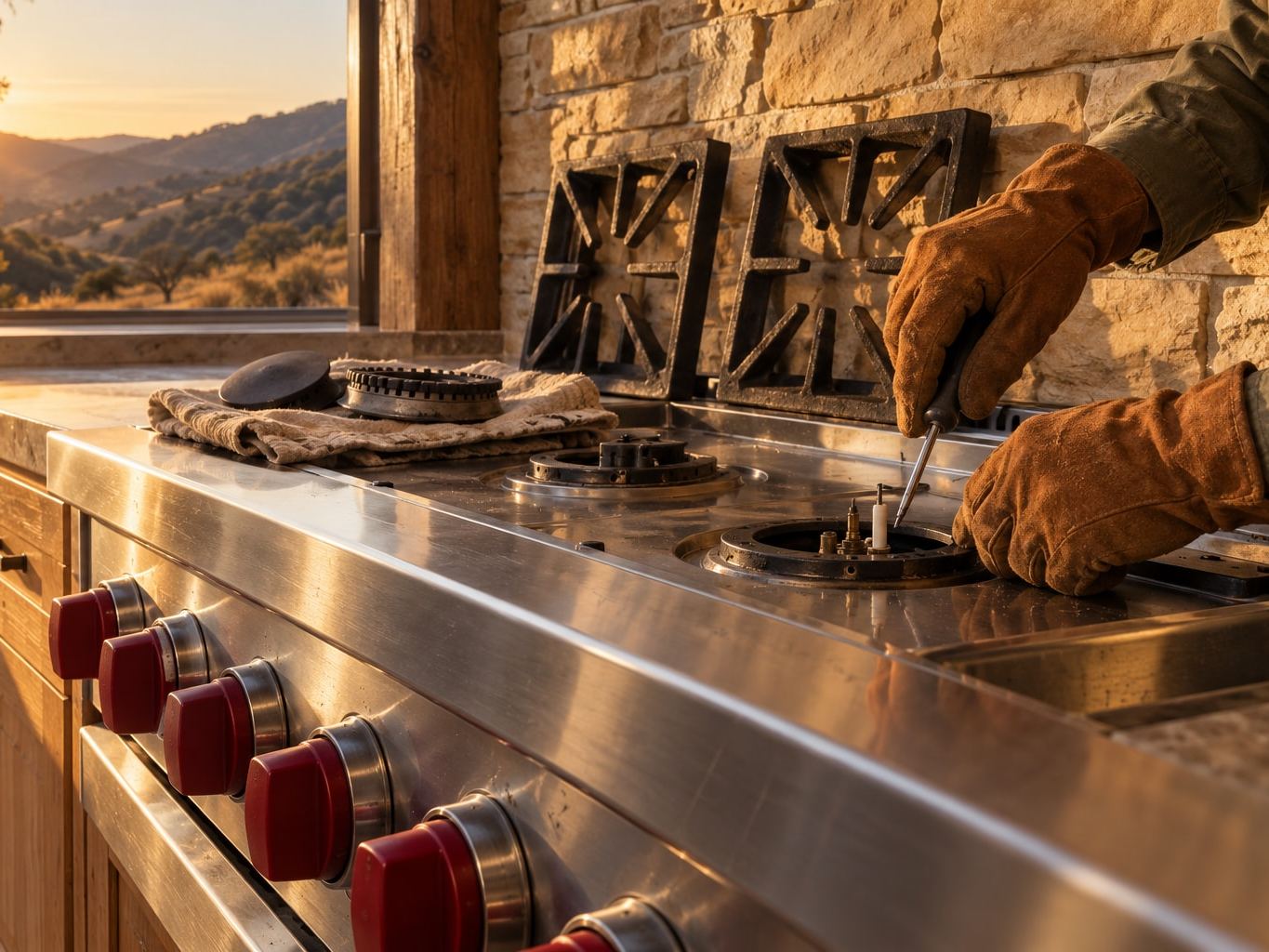
When did it start, what was cooking, did anything spill? Then the grates come off, caps and port rings get inspected, and the oven door opens before any meter comes out of the case.
-
Test, don't assume
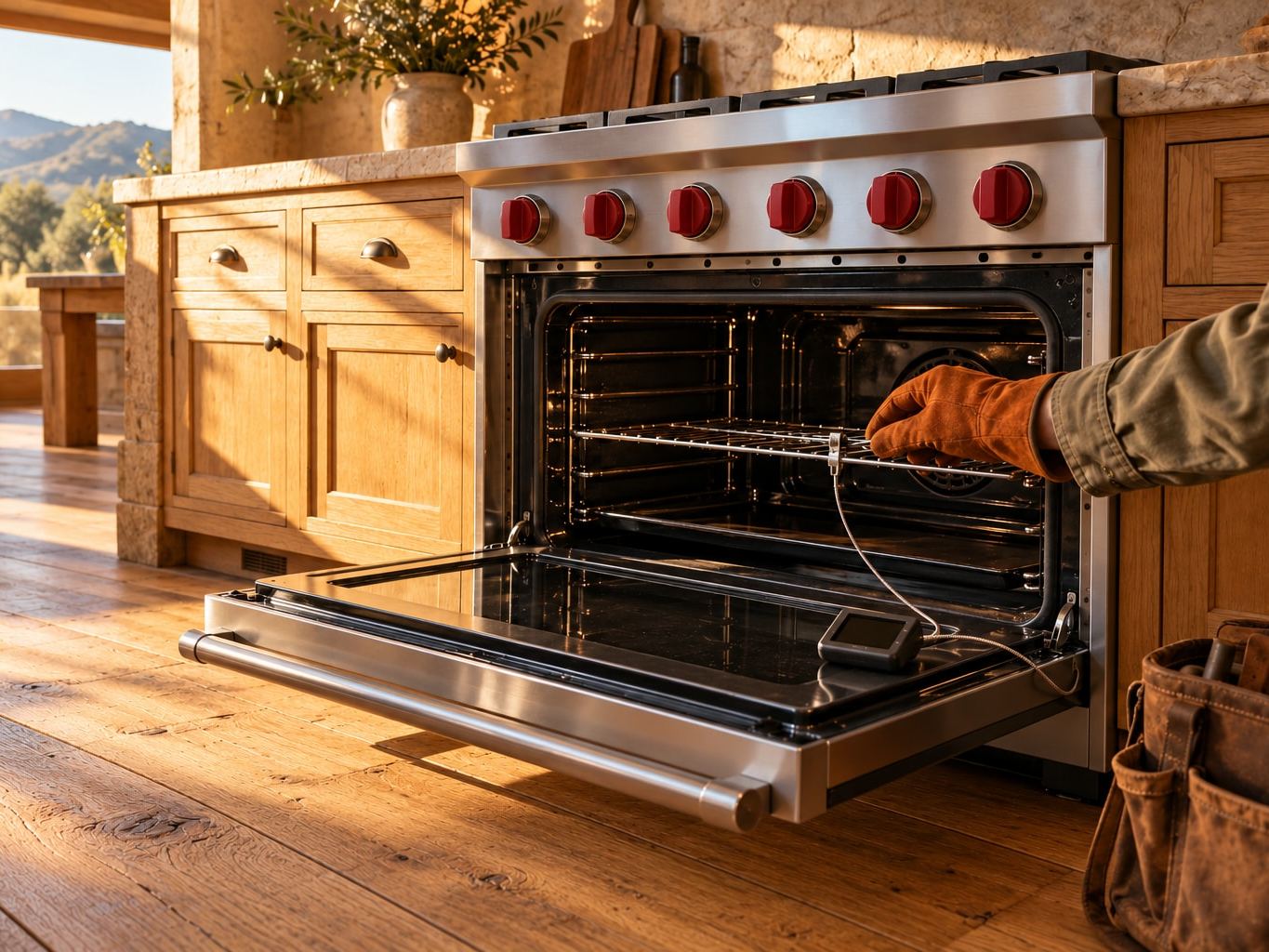
Spark at each electrode, resistance through each element, the probe's reading and the voltage feeding the controls all get checked, so the conclusion comes from the meter rather than from the symptom.
-
A price at the range
The technician names the culprit and the cost of fixing it right there beside the range, and nothing gets pulled or ordered without your nod. Approve it and the $89 you already paid goes toward the bill; our pricing page gives the reasoning.
-
The repair itself
A worn part gets swapped, or a burner gets cleaned out, seated and tuned. If something must come from the supplier, the next visit goes on the calendar together with you before the technician drives off.
-
Every flame, then the oven
Each burner is lit at a simmer and at full flame, and the oven climbs to baking heat, so a second weak point cannot hide behind the first.
Compass check 2 of 3
Why does my Wolf range oven work but the burners won't light?
The burners and the oven are separate systems sharing one body. Burners on gas and dual-fuel Wolf ranges need working spark electrodes, a spark module and open ports; the oven uses its own heat source and controls. When no burner lights, suspect the spark module or its power supply; when just one stays dark, inspect that burner's cap, ports and electrode.
Five minutes with the range before you call
A few looks that occasionally fix the problem outright and always shorten the visit.
- Pull each burner cap and lower it back so it sits level and fully seated
- After a spill, dry the area around the spark electrode and wait before relighting
- Glance at the oven screen: a dark display plus working burners narrows the search
- Jot down which burners act up, and whether at simmer, full flame or both
- Confirm your fuel type (all-gas, dual fuel or induction) and the width in inches
- Copy any display message word for word, letters and digits included
Burner myths worth dropping
-
Heard around town
Any cap position works as long as the burner is covered.On the groundA cap needs to lie level and centered on its base. Knocked even a little off center, it chokes some ports and floods others: you see a lopsided, yellowish or lifting flame, and sometimes the burner won't catch at all.
-
Heard around town
Nonstop clicking means a dead igniter.On the groundMore often the electrode sparks just fine and the module simply cannot confirm a flame because of water, grime or a crooked cap. Dry everything and reseat the cap before suspecting parts.
-
Heard around town
An oven fault means dragging the range out of the kitchen.On the groundThe oven shares the frame but keeps its own elements or burner, probe and controls, and a good deal of that work gets done with the range staying in its opening.
Compass check 3 of 3
Is it worth repairing a Wolf range?
Usually it is. Wolf builds its ranges from parts that can be swapped one at a time, such as electrodes, burner valves, bake elements, probes and control boards, so one bad component seldom means a new range. Whether yours deserves the repair depends on which part died and the condition of the rest; the diagnosis gives you that price before you commit.
Range repair, place by place
Eleven communities, eleven pages about Wolf ranges in their kitchens. Weighing a model? Read choosing the right Wolf. Curious about what sits under the grates? Try the technology inside your Wolf.
- Calabasas
Local repair
Old Town, Las Virgenes Road and gated hillside communities.
- Hidden Hills
Local repair
Gated ranch properties, roomy kitchens, long private drives.
- Westlake Village
Local repair
Lakeside homes and the Lindero Canyon corridor.
- Agoura Hills
Local repair
Slopes below Ladyface Mountain, off Kanan Road.
- Woodland Hills
Local repair
From Warner Center south into the hills.
- Tarzana
Local repair
Ventura Boulevard and the slopes climbing south of it.
- Encino
Local repair
The valley floor and the Encino Hills overhead.
- Thousand Oaks
Local repair
Conejo Valley streets on the Ventura County side.
- Oak Park
Local repair
A quiet Ventura County community beside Kanan Road.
- Malibu
Local repair
Beach and canyon homes reached by Pacific Coast Highway.
- Sherman Oaks
Local repair
South-of-the-boulevard hills near the 101 and 405 interchange.
What callers ask about Wolf ranges
- Will someone come out today for my Wolf range?
- If a slot is open, yes. Technicians drive out 8 AM–6 PM, seven days; the phone line stays open 24/7. Should the fix require a part from the supplier, you hear so during the visit and the follow-up date is set right then.
- Is every appliance on the visit billed at $89?
- No. The $89 pays for getting a technician to your door. Ask for a look at the wall oven or hood on that same stop and the charge stays one $89, which then comes off once a repair gets your go-ahead.
- Do you work on dual-fuel and induction Wolf ranges too?
- Yes, all three builds. From across the kitchen they look nearly identical, yet inside they share little, so mention which one you own when booking; that decides what goes in the toolbox.
- Does a range oven get repaired like a wall oven?
- Electrically there is plenty in common with a Wolf wall oven; an all-gas range oven, though, carries its own burner and igniter. Rangetops and cooktops with no oven beneath live on the cooktop page, and the contact page has the number and the booking link.
Bring every burner back to a clean blue flame
Dial (213) 516-4020 or grab a slot online: one $89 visit, credited once the repair goes ahead.
$89 pays for the drive whether one Wolf piece or the whole line gets tested; approve the repair and the invoice shrinks by that same $89.